


Creating augmented reality (AR) experiences that incorporate interactive, branching narratives is one of the most powerful ways to engage and captivate modern audiences. These narratives allow users to shape the outcome of the story through their choices whether it’s selecting a path in an adventure, interacting with a product feature, or responding to a scenario in a training simulation. The result is an experience that feels personal, immersive, and dynamic, fostering a deeper connection between the user and the content.
Picture an AR story where users are no longer passive viewers, but active participants. They can make decisions in real-time turn left or right, choose to trust a character or not, examine a product up close or move on to the next. Every decision changes the trajectory of the narrative, creating a unique journey for each user. This kind of storytelling is especially impactful in AR games, educational content, virtual training, and interactive product demonstrations.
However, designing such experiences manually is often a daunting task. Mapping out multiple storylines, ensuring logical consistency, and managing user inputs can quickly become overwhelming even for seasoned developers and writers. That’s where AI agents come in.
AI agents can streamline this process significantly by generating adaptive, branching storylines based on user data, contextual cues, or predefined goals. Instead of writing every possible path manually, creators can define key moments and let AI fill in the details, generating natural and engaging narrative variations in real time. Whether you’re creating a choose-your-own-adventure story, a hands-on tutorial, or a multi-outcome product walkthrough, AI allows for scalable, customisable content generation with minimal effort.
In this article, we’ll explore how AI agents can simplify and accelerate the development of branching narratives for AR videos. You’ll learn how they work, why they’re valuable, and how to start using them to deliver more interactive, personalised AR experiences that truly stand out.
Why Use AI Agents for Branching Narratives in AR Videos?

Incorporating branching narratives into AR videos can transform a simple immersive experience into an engaging, story-driven journey tailored to each user. However, creating these nonlinear storylines manually can be complex and time-consuming. That’s where AI agents prove incredibly valuable. Below are some of the key reasons to use AI agents when developing branching narratives in AR video content.
1. Dynamic Content Adaptation

One of the most compelling advantages of using AI agents in AR storytelling is their ability to adapt content dynamically in response to real-time user input. Unlike traditional linear narratives, which follow a fixed script regardless of user behaviour, AI-driven branching stories are fluid and responsive shifting direction based on how users interact with the experience.
Imagine an AR scenario where a user chooses to interact with a glowing portal instead of exploring a nearby object. Rather than forcing the user back onto a predetermined path, the AI instantly adjusts the storyline to accommodate that choice perhaps transporting them to a new location, triggering a unique interaction, or changing the behaviour of in-world characters. This immediate responsiveness makes the story feel alive and tailored, giving users a true sense of agency.
This kind of adaptability transforms users from passive viewers into active participants. Every decision no matter how small can influence the environment, dialogue, and outcomes. It’s not just about choosing a path; it’s about shaping the narrative moment by moment.
AI agents make this possible by interpreting user behaviour in real time tracking inputs such as where users look, what they touch, or which characters they engage with. Based on this data, the AI selects and delivers the most contextually relevant content, whether it’s a scene, animation, line of dialogue, or prompt. The result is an experience that feels personal, interactive, and emotionally engaging.
This level of dynamic content adaptation not only boosts user engagement but also keeps the experience fresh and replayable. Users are more likely to return and explore alternative outcomes, increasing the overall value and longevity of your AR content.
2. Simplified Story Mapping
Designing a branching narrative is like building a choose-your-own-adventure maze every decision a user makes leads to a new path, and each of those paths needs to connect logically and meaningfully to the next. When done manually, this process can be incredibly complex and time-consuming. Creators must carefully script every possible decision tree, anticipate user behaviours, and ensure that the story remains coherent and engaging no matter which path a user takes.
Each branch also has to be checked for consistency characters should behave in a believable way across all outcomes, story logic must hold up, and pacing needs to stay balanced regardless of the choices made. This often involves juggling multiple timelines, outcomes, and dependencies, which can quickly become overwhelming especially for large-scale AR projects involving dozens of user interactions and multiple endings.
This is where AI agents offer a significant advantage. Rather than manually crafting every node in the story map, creators can define a few core narrative points and let the AI generate the connecting threads. AI can help build out alternate paths, automatically suggest transitions that make sense, and even insert contextual dialogue that fits the user’s journey. This not only preserves narrative integrity but also dramatically speeds up development time.
AI tools also allow creators to visualise complex branching structures more clearly. Instead of static flowcharts, AI-powered platforms can dynamically adjust the story map as new branches are added or modified, helping teams spot weak links, remove redundancies, and optimise the overall experience.
By leveraging AI-driven story mapping tools, creators gain the flexibility to experiment with new ideas, explore more “what if” scenarios, and scale their content without getting bogged down in manual scripting. The end result is a richer, more interactive experience delivered in far less time, and with fewer resources.
3. Increased User Engagement
Interactive content inherently drives higher user engagement, and branching narratives amplify this effect by giving viewers control over the outcome. When users are empowered to make decisions whether it’s choosing how a character reacts or selecting which product feature to explore they feel more invested in the experience.
AI-generated branching paths allow for even greater levels of personalisation, which increases the likelihood that users will stay engaged longer. Each person’s journey can feel unique, and that novelty encourages users to rewatch or re-engage to see different outcomes. This kind of immersive storytelling builds emotional resonance, which is especially valuable in AR marketing, educational tools, or gamified learning environments.
4. Real-Time Adjustments
One of the standout advantages of AI agents is their ability to make real-time adjustments based on new user inputs or contextual changes. Unlike static scripts that require manual editing and re-coding, AI-generated narratives can evolve on the fly. This is particularly useful during prototyping and iteration phases, where creators often need to test multiple story flows and outcomes.
For instance, if initial user testing shows that a certain narrative branch is confusing or lacks engagement, AI can help quickly restructure that path without requiring a complete rewrite. Similarly, if you want to incorporate new user actions or environmental variables, AI can adjust the narrative accordingly, ensuring a smooth and responsive experience without starting from scratch.
This flexibility allows for faster development cycles and a more agile creative process. Instead of getting bogged down in technical adjustments, creators can focus on crafting compelling stories and enhancing user experience.
How to Use AI Agents to Generate Branching Narratives for AR Videos
Designing branching narratives can be a complex process, but AI agents make it easier by automating story generation, mapping user decisions, and ensuring narrative consistency. Here’s a step-by-step look at how to effectively use AI to bring your interactive AR stories to life.
1. Define the Story Framework and User Input Points
To begin building a successful branching narrative for your AR video, it’s essential to first define the overarching story framework. What is the core narrative you want to tell? Are you guiding users through a fictional adventure, an educational journey, or a product demonstration? Once you have a general outline, start identifying the key moments where users will interact with the story these are your decision points.
These input points should feel purposeful and intuitive. For instance, users might be asked to choose between two paths, respond to a character’s question, or decide what object to explore next. Each of these choices should influence the direction of the narrative in a noticeable way, encouraging users to stay engaged and explore different possibilities.
A good branching narrative isn’t just about giving options it’s about creating impact. When users realise their decisions lead to different outcomes, they feel more involved and curious to explore alternate paths.
How AI Helps:
AI agents can streamline this early phase by helping you map out the story’s architecture. Rather than manually drawing complex flowcharts, you can input your main plot points and let AI generate various branching possibilities. AI can identify logical places for user interaction, suggest alternative plotlines, and even flag inconsistencies or gaps in the narrative. This helps ensure a smooth and coherent user experience while saving you valuable planning time.
Example Prompt:
“Create a branching narrative where users can explore different paths in a magical virtual garden. Based on their actions such as touching a glowing plant, choosing a direction, or interacting with a creature the garden will change. Their choices will influence what types of flowers bloom, what sounds play in the background, and how the environment evolves.”
2. Automate Scene Transitions and User Decisions
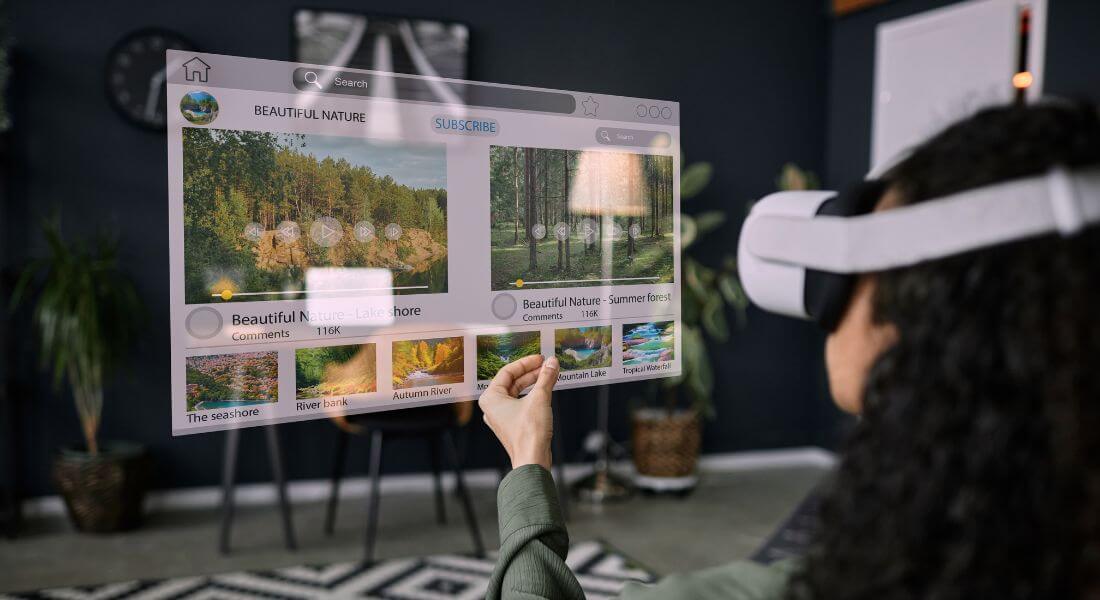
After you’ve mapped out your key decision points and story branches, the next critical step is to ensure that the transitions between scenes happen seamlessly based on the user’s choices. In a well-designed branching AR experience, users shouldn’t feel like they’re waiting for the next scene to load transitions should feel smooth, responsive, and intuitive.
Traditionally, setting up logic for these transitions involves manually scripting conditions, tracking user choices, and managing a network of scenes and outcomes. This can quickly become overwhelming, especially when dealing with multiple branches and potential outcomes.
How AI Helps:
AI agents can simplify this entire process by automatically generating the logic that controls how one scene flows into the next. When a user makes a selection like tapping on an object or choosing a path the AI can immediately trigger the corresponding scene, animation, or narrative shift. It can also keep track of cumulative decisions to influence future events or unlock unique outcomes, such as alternative endings or hidden scenes.
By handling complex logic trees and conditional pathways, AI allows creators to focus more on story development and user experience rather than getting bogged down in technical scripting.
Example Prompt:
“Generate logic that leads the user down different paths depending on whether they select the ‘dark forest’ or ‘bright meadow’ at the decision point. Each path should unlock different visual elements, ambient sounds, and character interactions that affect future scenes.”
4. Generate Interactive Prompts and Dialogue
One of the most engaging aspects of interactive AR videos is the inclusion of prompts and dialogue that invite the user to take part in shaping the story. These interactive moments whether they involve answering a character’s question, making a decision, or selecting an action are what make the narrative feel alive and responsive. Crafting these prompts effectively is essential to maintaining user immersion and momentum.
However, manually writing all the potential dialogue lines and prompts for each narrative branch can be time-consuming and may result in inconsistencies in tone or pacing. That’s where AI agents can become powerful creative collaborators.
How AI Helps:
AI can automatically generate context-sensitive dialogue and prompts that feel natural and relevant to the user’s current position in the story. Whether your experience is fast-paced and action-oriented or slower and more contemplative, AI can adjust the language, tone, and timing of prompts to suit the mood and flow of the narrative.
It can also account for the user’s previous choices, allowing characters to refer back to past decisions or tailor questions based on the evolving plot. This creates a deeper sense of connection between the user and the AR environment, making interactions feel more personalised and story-driven.
Example Prompt:
“Create interactive dialogue where the user is asked, ‘What will you do next? Choose to fight the dragon or flee the castle?’ The options should lead to different scenes and consequences, with characters reacting differently based on the user’s choice.”
5. Test and Adjust the Story Path in Real-Time
Once your branching narrative is fully mapped out and integrated into the AR environment, the next essential step is testing. No matter how well-designed the story may seem on paper, it’s only through testing that you can truly understand how users will experience it in real-time. This phase is critical for identifying pacing issues, logical inconsistencies, unclear decision points, or sections that may feel disconnected from the overall flow.
Traditionally, testing a complex interactive experience involves multiple manual reviews, rewrites, and back-and-forth editing. But AI can dramatically accelerate and improve this stage of the development process.
How AI Helps:
AI agents can simulate the user journey through the narrative, allowing you to experience each decision path as if you were the user. This enables you to catch potential issues early like a scene that feels too abrupt, a prompt that appears out of context, or a storyline that lacks emotional payoff. AI can also analyse user data and interaction patterns during beta testing to recommend improvements in flow, clarity, or interactivity.
In addition, real-time AI feedback allows for on-the-fly adjustments. Whether you need to rebalance pacing, fine-tune transitions, or modify a branching path, AI helps you iterate quickly without needing to rewrite entire segments from scratch.
Example Prompt:
“Preview the branching narrative and suggest improvements for any moments where the story feels too slow or disconnected between decisions. Highlight areas where user engagement might drop and propose alternatives to keep the momentum strong.”
Final Thought: Simplifying AR Storytelling with AI
Creating branching narratives for AR videos is no longer a daunting task, thanks to the power of AI agents. By automating the process of story mapping, scene transitions, and user prompts, AI helps speed up the development of interactive AR experiences that engage users and keep them coming back for more.
You can contact our augmented reality company in London to take your creativity to the next level. We combine AI-driven storytelling with immersive AR solutions to craft engaging and dynamic experiences that will captivate your audience.
